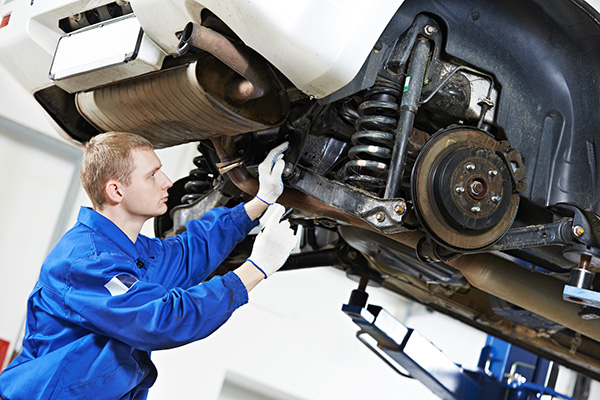
Suspension wear can sneak up on you because the change is rarely sudden. You get used to a little more bounce over a familiar road, a little extra lean around a curve, or a steering wheel that needs more correction than it used to. After a while, that new behavior starts to feel normal.
The suspension has more work to do than keeping the ride comfortable. Springs support the vehicle's weight, while shocks, struts, bushings, joints, and related parts control how that weight moves. When those parts stop doing their jobs well, tires, braking, steering, and overall stability begin to change too.
1. The Car Keeps Bouncing After a Bump
A healthy suspension should compress when the tire hits a bump and then settle quickly. If the body continues moving up and down after the road has leveled out, the shocks or struts may no longer be controlling the springs properly.
We usually notice the same problem over dips, railroad crossings, and uneven pavement. The vehicle can feel like it floats for a moment instead of settling back onto the road. Worn shocks or struts are common suspects, but you should also check weak springs, damaged mounts, and tire problems.
2. The Body Leans More in Corners
Some body movement during a turn is normal. What is not normal is feeling like the vehicle drops heavily onto the outside wheels, takes a second to catch up with the steering, or makes you slow down for curves you used to take comfortably.
Weak dampers, worn sway bar links or bushings, tired springs, and damaged control arm bushings can all add to that feeling. At our shop, a road test helps here because the way the vehicle transfers weight tells us something hard to see while it is sitting still on a lift.
3. The Front Dives Hard When You Brake
When you press the brake pedal, weight naturally moves toward the front of the car. Shocks and struts help control how quickly that happens. If the nose drops sharply and the rear feels unusually light, the suspension may not be controlling that weight transfer well anymore.
Brake problems can create their own instability, so we don't automatically blame the suspension. We look at brake operation, tire condition, front struts or shocks, springs, bushings, and alignment-related wear together. A vehicle that dives under braking and bounces over bumps gives us a stronger clue than either symptom by itself.
4. Your Tires Are Wearing in Strange Patterns
Tires are one of the best places to see what the suspension has been doing. Cupped or scalloped tread can develop when the tire repeatedly loses firm contact with the pavement. Inside-edge or outside-edge wear can point to alignment changes or suspension parts that no longer hold the wheel where they should.
Look for patterns such as:
- Cupped or scalloped sections across the tread
- One edge wearing much faster than the other
- One tire wearing differently from the rest
- Feathered tread across the surface
- Repeated tire wear even after an alignment
A tire can still have decent tread in the middle while being badly worn on the inside edge. During an inspection, we look beyond tread depth and check the joints, bushings, wheel bearings, shocks, struts, and alignment angles that could have created the pattern.
5. One Corner of the Car Sits Lower
Springs carry the vehicle's weight. If a coil spring cracks, sags, or loses strength, one corner can sit lower than the others. The difference might be obvious from across the parking lot, or it might only show up when you measure ride height.
A broken coil does not always fall out or make a loud noise. We sometimes find the bottom section broken inside the spring seat where it is difficult to see from the ground. A low corner can also affect alignment, tire wear, and how much suspension travel remains before the vehicle bottoms out over a bump.
6. The Car Feels Loose or Unsettled on the Road
Drivers describe this one in different ways. The car might wander on the highway, shift slightly after hitting a bump, feel nervous in crosswinds, or need constant small steering corrections. That does not automatically mean the steering system itself is bad.
Loose tie rods, ball joints, control arm bushings, worn shocks, wheel bearings, and tire problems can all change how the vehicle tracks. Regular maintenance gives us a chance to catch developing looseness before it becomes obvious from the driver's seat. If the vehicle suddenly feels less predictable, do not assume an alignment alone will fix it until the suspension and steering parts have been checked.
Get Suspension Repair In Sarasota, FL, With Kaufman's Auto Repair
If your vehicle bounces, leans, dives under braking, wears its tires unevenly, or simply feels less stable than it used to, Kaufman's Auto Repair in Sarasota, FL, can check the suspension, steering, and tires to find the source of the extra movement.
Schedule a visit to identify worn parts before they affect your next set of tires or how the car handles.